
Can Traffic Cameras Be Used to Enforce Traffic Laws in Nevada?
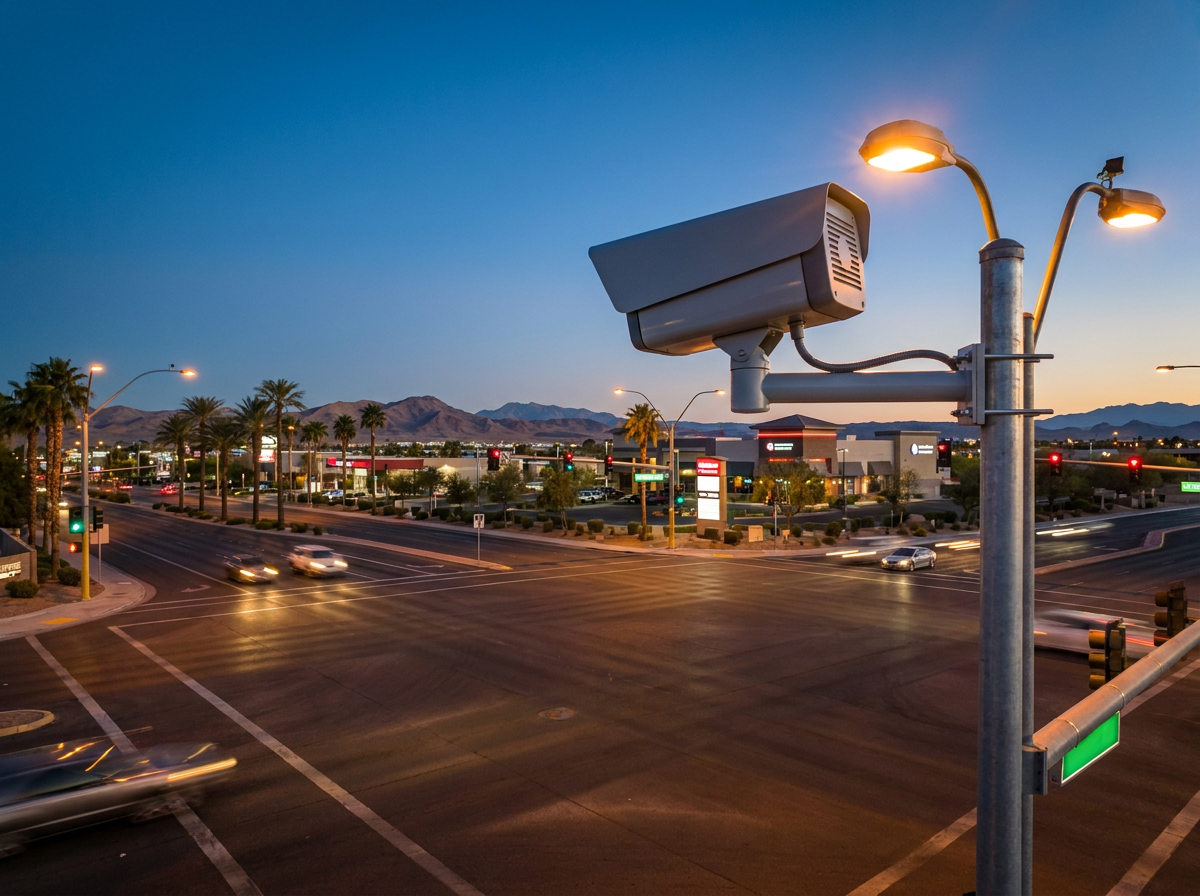
You've probably driven past a camera mounted on a traffic signal pole and wondered — could that thing actually ticket me? In many states across the country, the answer is yes. In Nevada, the answer has been a firm no for over two decades — with one significant new exception. Here's what Nevada law says, how the landscape shifted in 2025, and why serious civil liberties questions continue to shadow any broader effort to expand automated traffic enforcement.
Nevada's Clear Prohibition: NRS 484A.600
Nevada has had a statutory ban on automated traffic cameras since 1999. The current law, codified at NRS 484A.600, states plainly that: "A governmental entity and any agent thereof shall not use photographic, video or digital equipment for gathering evidence to be used for the issuance of a traffic citation or civil infraction citation… unless the equipment is a portable camera or event recording device worn or held by a peace officer, the equipment is otherwise installed temporarily or permanently within a vehicle or facility of a law enforcement agency or the equipment is privately owned by a nongovernmental entity."
In plain terms: the government cannot deploy fixed cameras — mounted at intersections, on poles, or on overpasses — to photograph or record drivers and use that footage to issue speeding or red-light citations. The only lawful exceptions are:
- Body cameras and dash cameras worn or held by a police officer;
- In-vehicle cameras installed inside a law enforcement vehicle; or
- Privately owned equipment operated by a nongovernmental entity (for example, a business's security camera — but even then, the footage cannot be the basis for a citation).
This means the automated red-light cameras you may have seen in other cities — the kind that snap a photo of your license plate and mail you a ticket — are currently illegal in Nevada as a tool of traffic enforcement.
How Did This Ban Come About?
Nevada enacted its ban on camera-based enforcement in 1999, at a time when red-light camera programs were proliferating in other states and generating significant controversy. Concerns about accuracy, revenue-motivated enforcement, due process, and privacy drove Nevada lawmakers to prohibit the practice outright. The statute was originally enacted as NRS 484.910 and was later renumbered and reorganized into today's NRS 484A.600 as part of a broader revision of the state's traffic code.
For more than 25 years, that ban has held. Nevada drivers have not received camera-generated traffic tickets the way drivers in states like Arizona, Maryland, or Washington D.C. have.
Is This Starting to Change?
The 2025 Nevada Legislative Session saw the most serious push in years to chip away at the camera ban.
Senate Bill 415 would have broadly authorized local jurisdictions to deploy automated traffic enforcement cameras at intersections and other locations. Backed by the Las Vegas Metropolitan Police Department and Clark County, the bill drew a fierce response from civil liberties groups and ultimately died in committee in April 2025 without advancing.
Assembly Bill 402 took a narrower approach, proposing a pilot program to allow automated speed cameras exclusively in active construction zones — and only when workers were present — to address the high rate of worker fatalities from speeding vehicles. That bill advanced further in the legislative process. Whether it was ultimately signed into law before the session adjourned on June 3, 2025 is worth checking with the Nevada Legislature's bill tracking system, as its final disposition may affect a narrow category of enforcement going forward.
For general red-light and speed cameras, NRS 484A.600 remains the law. But the 2025 session did produce one significant, enacted camera exception — and it is already in effect.
The School Bus Exception: NRS 484A.605 and Assembly Bill 527
The one camera enforcement program that did pass into law during the 2025 session is NRS 484A.605, created by Assembly Bill 527, which passed on June 6, 2025 and took effect July 1, 2025. Nevada thereby became the 29th state in the country to authorize stop-arm enforcement cameras on school buses.
What Drove the Legislation
The data that moved lawmakers was hard to ignore. The Clark County School District, working with a school bus safety vendor called BusPatrol, ran a pilot program from January to May 2025 equipping just 30 school buses with AI-powered stop-arm cameras. In those five months alone, the cameras captured 11,079 violations — drivers illegally passing stopped school buses with red lights flashing and children loading or unloading. That works out to an average of 5.6 illegal passings per bus, per day. That footage and data were presented to state legislators and became the driving force behind the bill's passage.
What NRS 484A.605 Actually Authorizes
The new statute creates a carefully bounded exception to the NRS 484A.600 prohibition. The board of trustees of a school district — not a law enforcement agency — may authorize the installation and use of a "school bus infraction detection system" on school buses it owns. These camera systems are used exclusively to enforce the existing law prohibiting drivers from passing a school bus that has stopped to receive or discharge pupils and is displaying flashing red lights (NRS 484B.353).
The statute includes a number of requirements designed to address the concerns that killed broader camera bills:
- Human review required. A peace officer of the traffic enforcement agency having jurisdiction must review the camera evidence before any civil infraction citation is issued. A camera alone cannot generate a ticket.
- Public awareness campaign. School districts installing a system for the first time must run a public awareness campaign for at least 30 days after the system is placed into use.
- Mandatory data destruction. Any photograph or recorded image produced by the system must be destroyed after a specified period of time — a direct response to concerns about government data collection and retention.
- Fine structure and use of proceeds. The existing fine structure applies (fines start at $250). Fines collected must be used by the school district for specific purposes — primarily to fund student transportation. This is a significant departure from general red-light camera programs, which critics have repeatedly condemned as revenue-generation tools for municipalities.
- Legislative reporting. Each school district using the system must prepare and submit an annual report to the Legislature, providing a level of oversight that the ACLU noted was absent in the broader SB 415.
The Key Legal Distinction: It's a Civil Infraction, Not a Moving Violation
Perhaps the most legally significant feature of NRS 484A.605 is what it explicitly says a school bus camera violation is not: it is not a moving traffic violation, and no demerit points are assessed against the driver's license. The bill amended the demerit point statutes to expressly exclude these citations from the point system.
This distinction matters. Because no points attach, the violation does not trigger license suspension thresholds, does not directly affect insurance rates the way a moving violation would, and substantially reduces the liberty-interest concerns that weigh most heavily in due process and constitutional challenges. Drivers who receive one of these citations are fined for the infraction, but their driving record is not impacted in the same way as a traditional moving violation.
Privacy and Constitutional Concerns
Even if Nevada were to change its law, automated traffic cameras raise serious constitutional questions that have drawn attention from civil liberties organizations and legal scholars alike.
Fourth Amendment — Unreasonable Searches and Seizures
The Fourth Amendment to the U.S. Constitution protects citizens from unreasonable government searches and seizures. Traditional legal doctrine holds that there is no reasonable expectation of privacy in what you do in public view — including driving on a public road. Under that reasoning, a camera capturing your vehicle running a red light shouldn't raise a constitutional problem.
However, the U.S. Supreme Court's landmark decision in Carpenter v. United States, 585 U.S. 296 (2018), has complicated that picture significantly. In Carpenter, the Court held that the government's access to historical cell phone location data — which revealed a person's movements over time — constituted a "search" under the Fourth Amendment, even though the data was technically shared with a third party (the phone carrier). The Court reasoned that the comprehensive, long-term tracking of a person's movements is qualitatively different from a single observation in public, and that the aggregation of such data creates a detailed record of private life that the Fourth Amendment was designed to protect.
That reasoning has direct implications for traffic camera networks. A single camera at a single intersection may be constitutional. But a city-wide grid of cameras that systematically logs the location and movement of every vehicle in real time begins to look much more like the kind of pervasive surveillance the Carpenter Court was concerned about.
Due Process Concerns
Beyond the Fourth Amendment, automated enforcement raises due process questions. When a camera issues a citation, there is often no officer who can testify about the circumstances, no opportunity to question a witness, and a presumption — sometimes written into statute — that the registered owner of the vehicle was the driver. Challenging that presumption, especially for rental cars or vehicles owned by someone other than the driver, can be difficult or effectively impossible.
The ACLU of Nevada's Opposition
The ACLU of Nevada was one of the most vocal opponents of SB 415 during the 2025 session. Executive Director Athar Haseebullah stated: "The deployment of red-light cameras is often framed as a matter of public safety, but in reality, most civil liberties abuses happen under the guise of public safety. Automated traffic enforcement systems, which raise significant constitutional concerns, are problematic tools that are used to generate revenue for the government on the backs of ordinary Nevadans."
The ACLU also flagged data collection and data-sharing concerns — pointing out that the Legislature itself has limited ability to oversee how data collected through automated enforcement systems is stored, accessed, or shared with other law enforcement agencies. Other jurisdictions have paid tens of millions of dollars in settlements due to faulty or improperly operated camera systems.
While no Nevada state court has had occasion to rule on the constitutionality of a general traffic camera program — because the practice has been banned — the constitutional questions raised by camera enforcement are live and serious issues that courts in other states have grappled with, and that any Nevada program would eventually face.
Why School Bus Cameras Passed Where Others Didn't
It is worth noting that many of the constitutional and civil liberties objections raised against SB 415 are substantially mitigated in the NRS 484A.605 school bus program:
- Cameras are mounted on the bus itself, not on fixed infrastructure throughout the public roadways — limiting the scope of surveillance to a discrete, moving location rather than a citywide monitoring grid.
- Human officer review is required before any citation issues, addressing the due process concern about a machine unilaterally charging citizens with violations.
- No demerit points means the liberty interest at stake is reduced — the citation is a civil fine, not a record-affecting moving violation.
- Mandatory data destruction answers the data retention and potential surveillance-creep concerns that troubled the ACLU in the broader bills.
- A compelling government interest — the safety of children boarding and departing school buses — is one of the strongest justifications available under constitutional law, and it is far easier to defend in court than the revenue-and-throughput rationale underlying general speed and red-light camera programs.
The ACLU of Nevada did not publicly oppose AB 527 the way it did SB 415, and the bill passed with broad, bipartisan support. The combination of a specific, targeted safety purpose, meaningful procedural safeguards, and the absence of demerit points made the constitutional calculus significantly different from general automated enforcement.
What This Means for You
If you received a traffic ticket in Nevada, it was issued by a law enforcement officer — not a camera. The ticket is the result of a human officer observing the violation, which also means you have the right to contest it with cross-examination and challenge the officer's observations directly.
If you have a ticket and want to understand your options — including whether points on your record can be avoided — an experienced Nevada traffic ticket attorney can often help you achieve a better outcome than handling it alone.
Cap & Kudler represents clients in traffic ticket cases throughout Clark County, Nevada. Contact us to discuss your case.
Footnotes
¹ NRS 484A.600 (2025): "A governmental entity and any agent thereof shall not use photographic, video or digital equipment for gathering evidence to be used for the issuance of a traffic citation or civil infraction citation pursuant to NRS 484A.7035 for a violation of chapters 484A to 484E, inclusive, of NRS unless the equipment is a portable camera or event recording device worn or held by a peace officer, the equipment is otherwise installed temporarily or permanently within a vehicle or facility of a law enforcement agency or the equipment is privately owned by a nongovernmental entity." (Added to NRS by 1999, 3278; A 2021, 3321 — substituted in revision for NRS 484.910.)
² Carpenter v. United States, 585 U.S. 296 (2018). The Supreme Court held, 5–4, that the government's warrantless acquisition of historical cell-site location information from a wireless carrier constituted a search under the Fourth Amendment. Chief Justice Roberts, writing for the majority, emphasized that the "seismic shifts in digital technology" required the Court to ensure that the "progress of science" does not erode Fourth Amendment protections.
³ NRS 484A.605 (2025) — AB 527, enacted June 6, 2025, effective July 1, 2025: The statute authorizes the board of trustees of a school district to install and use a school bus infraction detection system on school buses owned by the district to enforce NRS 484B.353 (prohibiting passing a stopped school bus displaying a flashing red light signal). Key provisions require: (a) peace officer review of evidence before any citation is issued; (b) a public awareness campaign of not less than 30 days before the system is first placed into use; (c) destruction of photographs and recorded images after a specified period; (d) use of fine proceeds for school district transportation purposes; and (e) annual legislative reporting by each participating school district. Citations issued under this statute are expressly classified as civil infractions, not moving traffic violations, and no demerit points are assessed. (Added to NRS by 2025 — AB 527, 83rd Legislative Session.)
Got a Traffic Ticket?
Tell us what you're dealing with and we'll explain your options — free of charge.
Free Case Review