
Flock Cameras in Nevada: Surveillance Tool or Traffic Enforcement Device?
Estimated read time: 5 minutes
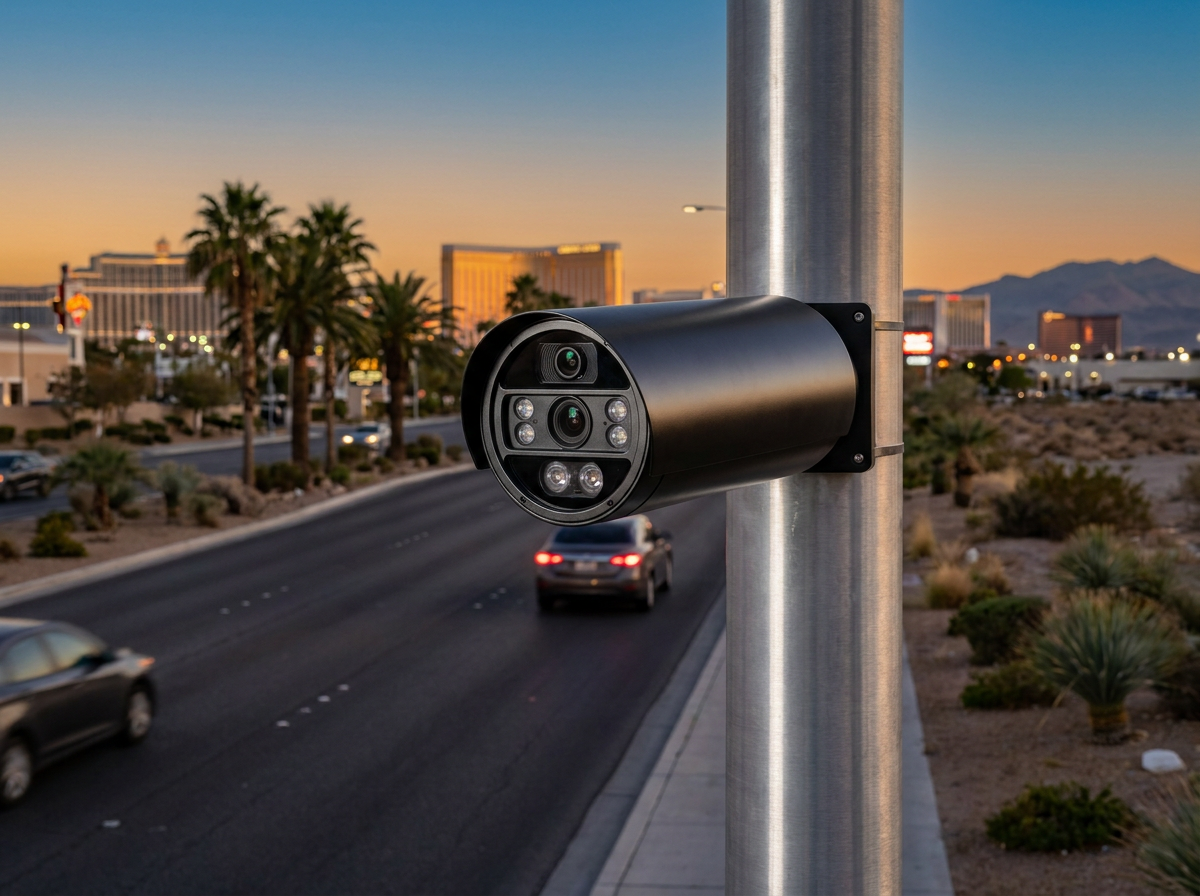
If you drive in the Las Vegas Valley, there is a good chance you have been photographed by a Flock camera without knowing it. These devices are spreading rapidly across Nevada and the rest of the country, and they raise serious questions about privacy, constitutional limits, and — for our purposes — whether they can be used to enforce traffic laws. The short answer is nuanced: Flock cameras are not traffic enforcement cameras in the traditional sense, but the line between surveillance and enforcement is blurring in ways the law has not yet fully addressed.
What Are Flock Cameras?
Flock Safety is an Atlanta-based technology company founded in 2017 that manufactures and operates one of the largest networks of Automated License Plate Reader (ALPR) cameras in the United States. The cameras are now deployed by police departments, private homeowners' associations, and businesses across the country.
Unlike a red-light camera or speed camera — which is triggered by a traffic violation and designed to automatically generate a citation — a Flock camera operates differently. It does not wait for a violation. It captures data on every vehicle that passes by, continuously and automatically, regardless of whether the driver has done anything wrong.
Here is what a single Flock camera captures about your vehicle in a fraction of a second:
- License plate number — read and recorded by optical character recognition
- Vehicle make, model, and color
- Distinguishing features — dents, bumper stickers, roof racks, tire brand, and other identifying characteristics
- Location, date, and time of the detection
This information is immediately uploaded to Flock's cloud system, where it becomes searchable not just by the agency that operates the camera, but by thousands of other law enforcement agencies nationwide that participate in the network — often without the knowledge of the drivers recorded, without a warrant, and without any requirement that the driver be suspected of a crime.
Flock Safety markets its product primarily as a criminal investigation tool — helping police locate stolen vehicles, identify suspects, and reconstruct the movements of a person connected to a crime. The company's website describes its technology as creating "objective, searchable evidence." What it does not say is that this evidence is generated by recording everyone, all the time.
Flock Cameras in Las Vegas and Nevada
The Las Vegas Metropolitan Police Department (LVMPD) has been using Flock cameras since 2019 and now operates approximately 211 Flock cameras throughout the Las Vegas Valley, alongside roughly 130 Motorola license plate readers. In just one recent 30-day period, those cameras detected more than 2.3 million vehicles, resulting in more than 4,400 individual database searches and over 14,000 "hotlist hits" — alerts flagging vehicles associated with active investigations.
Many of these cameras were obtained by LVMPD through a vendor program in which cameras are provided to law enforcement agencies at reduced or no cost — often described publicly as a "gift." That framing is legally significant, as discussed below.
Nevada is currently one of 34 states with no specific legislation regulating ALPR cameras. No bill addressing ALPR use, data retention, or data sharing was introduced in Nevada's 2025 legislative session. As of today, there are no state-law limits on how long Flock data can be retained, who it can be shared with, or what purposes it can be used for.
Are Flock Cameras Traffic Enforcement Cameras?
This is the critical distinction, and it matters enormously for how the law applies.
Flock cameras are surveillance cameras, not traffic enforcement cameras. A traditional traffic enforcement camera — the red-light cameras banned under NRS 484A.600 — is triggered by a specific traffic violation (running a red light, exceeding the speed limit) and is set up for the express purpose of documenting that violation to generate a citation. The camera is the enforcement mechanism.
A Flock camera does none of that. It captures all traffic indiscriminately, stores the data in a searchable database, and relies on human officers to query that database when investigating a specific crime or incident. No citation is automatically generated. No ticket arrives in the mail. The camera does not "enforce" traffic laws on its own.
That said, the data a Flock camera collects could theoretically be used in connection with a traffic matter. If, for example, an officer is investigating a hit-and-run and pulls Flock footage to identify a vehicle that fled the scene, that footage could become relevant evidence. But this is a far cry from automated traffic enforcement — it still requires human review, a specific investigative purpose, and the exercise of officer judgment.
What Does NRS 484A.600 Say — And Does It Apply?
Nevada's camera ban, codified at NRS 484A.600, prohibits government entities from using "photographic, video or digital equipment for gathering evidence to be used for the issuance of a traffic citation or civil infraction citation" unless the equipment falls within specific exceptions.
That prohibition is purpose-specific: it targets equipment used to gather evidence for a citation. Because Flock cameras are not deployed for citation purposes — they are deployed for general surveillance and criminal investigation — NRS 484A.600 does not, on its face, bar their use.
There is also a structural argument that Flock cameras may fall within the statute's "privately owned by a nongovernmental entity" exception. When cameras are supplied to law enforcement through a vendor arrangement where Flock (a private company) owns and operates the network, that argument has some surface plausibility — though it is untested in Nevada courts.
The bottom line: NRS 484A.600 was designed to stop red-light and speed cameras from mailing tickets to drivers. It was not written with mass-surveillance ALPR networks in mind. Whether it should be extended to cover Flock-style surveillance is a question the Nevada Legislature has not yet answered — and as of the 2025 session, has not even debated.
Privacy and Constitutional Concerns
The constitutional questions raised by Flock cameras are, if anything, more serious than those raised by traditional traffic enforcement cameras — because the scope of surveillance is so much greater.
The Fourth Amendment Problem
The U.S. Supreme Court's decision in Carpenter v. United States, 585 U.S. 296 (2018), significantly expanded Fourth Amendment protection against government tracking. The Court held that the comprehensive, long-term recording of a person's movements creates a detailed record of private life that cannot be obtained without a warrant — even when individual data points would not individually raise constitutional concerns.
A citywide network of 211 Flock cameras recording the movement of every vehicle in the Las Vegas Valley sits squarely in Carpenter territory. No individual camera reading tells you much about a person's life. But the aggregated record of where a vehicle was, when, at what time, on what days, over weeks and months — that is exactly the kind of comprehensive location history Carpenter said the government cannot access without a warrant.
The Split in the Courts
Courts are actively grappling with this question right now, and they are not reaching consistent results.
In United States v. Martin (D. Kan.), a federal district court held that warrantless law enforcement searches of a Flock database did not violate the Fourth Amendment because vehicles traveling on public roads have no reasonable expectation of privacy. The court applied traditional public-roads doctrine — the same reasoning that long supported red-light camera programs before Carpenter.
But in Commonwealth v. Bell (Norfolk Circuit Court, 2024), a state court judge reached the opposite conclusion, holding that accessing Flock ALPR data without a warrant did violate the Fourth Amendment, relying heavily on Carpenter's aggregation principle.
Most recently, a federal judge ruled in January 2026 that Norfolk, Virginia's 176-camera Flock network does not currently violate the Fourth Amendment — but the judge's opinion included notable caveats, and the case is being closely watched by civil liberties organizations nationally.
The Institute for Justice, a national civil liberties law firm, has an active lawsuit challenging Norfolk's Flock system, arguing that the camera network gives the government "unprecedented powers of surveillance that upset traditional expectations of privacy." Flock Safety itself attempted to intervene in that case to block the challenge and was rejected by the federal court.
Nevada-Specific Concerns: No Rules, No Oversight
The constitutional debate may ultimately be resolved by the federal courts, but Nevada's complete absence of state-level ALPR regulation means that in the meantime, there are no guardrails at all on how the data is used:
- No retention limits — Flock data can be stored indefinitely under current Nevada law.
- No sharing restrictions — LVMPD can share data with any other Flock-participating agency nationwide, including federal immigration enforcement, without any state-law restriction.
- No audit requirements — There is no state mandate that agencies track or report what searches are conducted, for what purpose, or what the outcomes were.
- No warrant requirement — Nevada law does not require a warrant before an officer queries the Flock database, even to reconstruct months of a person's driving history.
The ACLU has described Flock's network as one of the most powerful and least regulated mass surveillance systems in American history — and Nevada, with its 200-plus LVMPD cameras and zero regulation, is one of the more striking examples of that description.
What This Means If You Receive a Traffic Ticket in Nevada
For now, if you receive a traffic ticket in Nevada, it was issued by a law enforcement officer who observed the violation directly — not by an automated camera. NRS 484A.600 still prohibits automated citation issuance, and Flock cameras are not in the citation business.
However, if you are involved in a more serious traffic matter — a hit-and-run investigation, a reckless driving accusation, or any incident in which law enforcement is trying to reconstruct the movements of a vehicle — Flock data may well become part of the investigation without your knowledge and without a warrant.
The law on automated license plate readers is evolving rapidly. Nevada's legislature has yet to engage with it. If you have questions about a traffic matter and how evidence against you may have been gathered, speaking with an experienced Nevada traffic attorney is the best first step.
Cap & Kudler represents clients in traffic ticket cases throughout Clark County, Nevada. Contact us to discuss your case.
Additional Resources
Have I Been Flocked? (haveibeenflocked.com) — A public-records research project that lets you search whether your license plate appears in known Flock database searches and publishes detailed reports on how law enforcement agencies across the country are using the system.
DeFlock (deflock.org) — An open-source project that maps the locations of Flock and other ALPR cameras across the United States, allowing you to see how many of these surveillance devices are deployed in your area.
Footnotes
¹ NRS 484A.600 (2025): "A governmental entity and any agent thereof shall not use photographic, video or digital equipment for gathering evidence to be used for the issuance of a traffic citation or civil infraction citation pursuant to NRS 484A.7035 for a violation of chapters 484A to 484E, inclusive, of NRS unless the equipment is a portable camera or event recording device worn or held by a peace officer, the equipment is otherwise installed temporarily or permanently within a vehicle or facility of a law enforcement agency or the equipment is privately owned by a nongovernmental entity." (Added to NRS by 1999, 3278; A 2021, 3321 — substituted in revision for NRS 484.910.)
² Carpenter v. United States, 585 U.S. 296 (2018). The Supreme Court held, 5–4, that the government's warrantless acquisition of historical cell-site location information constituted a search under the Fourth Amendment, reasoning that the comprehensive, long-term aggregation of location data reveals the "privacies of life" in a way that a single observation in public does not.
³ Commonwealth v. Bell (Norfolk Circuit Court, 2024). A Virginia state circuit court judge held that law enforcement's warrantless access to Flock ALPR data violated the Fourth Amendment, applying Carpenter's aggregation reasoning to license plate reader networks.
⁴ Pitcher v. City of Norfolk (E.D. Va., Jan. 27, 2026). A federal district court ruled that Norfolk's 176-camera Flock network does not currently violate the Fourth Amendment under existing doctrine, while the Institute for Justice's appeal and broader litigation continues to develop the law in this area.
Got a Traffic Ticket?
Tell us what you're dealing with and we'll explain your options — free of charge.
Free Case Review